

Stacy Stanley | December 30, 2025 | Car Accidents
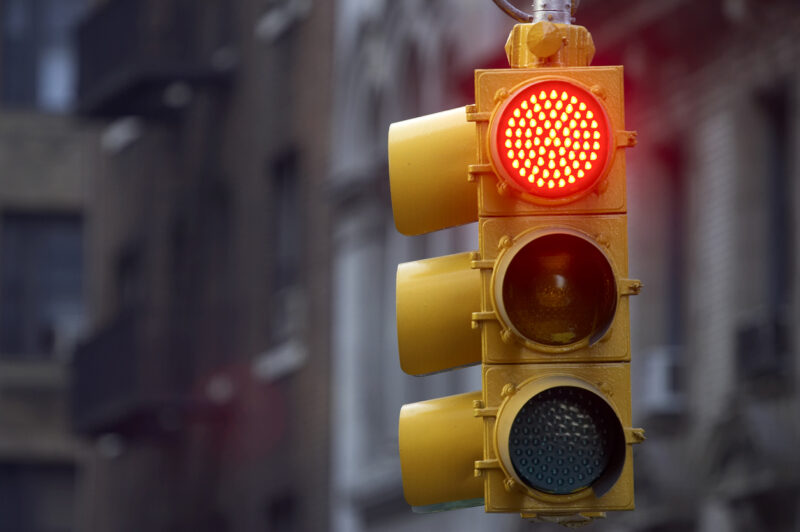
Intersections with flashing lights can be confusing, especially when they replace the familiar red, yellow, and green signals drivers rely on every day. Whether you’re approaching a flashing red light, a flashing yellow light, or a combination of both, knowing how to respond is critical for staying safe and avoiding traffic violations.
Understanding what these signals mean—and how to act when you encounter them—can help prevent accidents and keep traffic flowing smoothly.
Flashing Yellow Lights
When you approach an intersection with flashing yellow lights, you should treat it as though it had a yield sign. That means you should slow down as you approach the intersection and determine whether it is safe to proceed.
If traveling through the intersection would be safe, you can enter it cautiously. However, if another vehicle is blocking your way, you need to stay out of the intersection until it is safe to enter. In some situations, this may require you to stop to prevent a car accident.
Flashing Red Lights
According to South Carolina law, flashing red lights are equivalent to stop signs. This means that when you approach an intersection with a flashing red light, you must stop your car before entering the intersection. Stop behind the thick white line if there is one on the road.
What you do next depends on the cross lane. If the cross lane also has a flashing red light, then the intersection is effectively a four-way stop. You may proceed through the intersection in the order that each vehicle reached the intersection. If another car reached the intersection at the same time as you, the right-most vehicle has the right of way.
However, if the cross lane has a flashing yellow light, then your lane is governed by different rules. In this situation, you must wait to proceed through the intersection until you can pass through it without interrupting the flow of traffic in the cross lane. If you violate this rule and get into an accident, you will be responsible for the collision.
Why Do Flashing Lights Exist?
Flashing yellow and red lights are equivalent to yield and stop signs, respectively. There are two reasons that these lights are used to control traffic.
The first reason is visibility. Flashing red and yellow lights are visible at long distances and at night. This is particularly important in areas that have poor lighting or on roads with high speed limits. A flashing light might also be used at an intersection where the surrounding foliage could block a traffic sign.
Flashing lights may also be used when a traffic light has a burned-out bulb. For example, if the red bulb is burned out on a traffic light, it can be reprogrammed to flash yellow until a street crew has time to replace the bulb.
Common Mistakes Drivers Make at Flashing-Light Intersections
Many accidents at flashing-light intersections happen because drivers misunderstand who has the right of way or fail to slow down and assess traffic conditions. A common mistake is treating a flashing yellow light as permission to speed through the intersection without caution, or rolling through a flashing red light without coming to a complete stop.
Other drivers may assume cross traffic will stop when it actually has the right of way. Staying alert, obeying the proper rules for each signal, and never making assumptions about other drivers’ actions can significantly reduce the risk of a serious collision.
Contact Stanley Personal Injury Lawyers for a Free Consultation
Intersections with flashing lights are designed to keep traffic moving safely when standard signals aren’t in use, but they require drivers to pay close attention and follow the correct right-of-way rules. By knowing when to yield, when to stop, and when it is safe to proceed, you can reduce your risk of a collision and help protect everyone on the road.
If you were injured in an accident involving a flashing-light intersection or believe another driver failed to follow these rules, Stanley Personal Injury Lawyers can help you understand your options. Contact our team today for a free consultation to discuss your case and your rights.
For more information, please contact Stanley Personal Injury Lawyers to schedule a free consultation with a personal injury lawyer in North Myrtle Beach, Little River, Aynor, or across South Carolina.
We proudly serve Horry County and its surrounding areas.
Stanley Personal Injury Lawyers – Little River Office
3303 Hwy 9 E, Little River, SC 29566, United States
(843) 390-9111
Stanley Personal Injury Lawyers – North Myrtle Beach Office
By Appointment Only
1016 2nd Ave N Suite F, 2nd Floor, North Myrtle Beach, SC 29582
Stanley Personal Injury Lawyers – Aynor Office
By Appointment Only
604 8th Ave, Aynor, SC 29511